





In brief
- Senate Republicans released a revised Clarity Act Sunday—their "last, best and final offer"—ahead of Tuesday's cloture vote, which needs 60 votes and thus at least seven Democratic crossovers.
- Trump signed off on tougher ethics rules he'd previously resisted, including divestment or blind trusts, state AG enforcement and no sunset date; other changes touched the Blockchain Regulatory Certainty Act (dropping criminal-prosecution protections) and added stablecoin "circuit breaker" language.
- Early industry reaction leans positive, with Galaxy's Alex Thorn raising his 2026 passage odds from 10% to 25%, though the tight calendar remains a hurdle.
A renewed sense of optimism is sweeping through the crypto industry as it heads into one of its most consequential policy weeks on record.
On Sunday night, Senate Republicans released a new version of the Clarity Act featuring changes to several key provisions in a final attempt to shore up Democratic support ahead of Tuesday’s procedural vote on whether to advance the bill. Invoking cloture on the motion to proceed will require 60 senators to vote yes, meaning Republicans will need at least seven Democrats to cross the aisle, and potentially nine or ten depending on Republican defections.
The latest package, which Republicans are calling their “last, best and final offer,” contains a revised ethics proposal with a stamp of approval from President Donald Trump, along with concessions on other major sticking points that have dogged negotiations for much of the past year, including the Blockchain Regulatory Certainty Act, stablecoin yield and the so-called “Ag title.”
Senate Democrats held two meetings Sunday, including one with the entire caucus, before the text was released. They have yet to engage with the new proposal, but Republicans are already daring them to vote against a bill they say now incorporates more than 120 of their demands.
“A no vote on Tuesday means opposing real ethics reforms on politicians’ personal investments, handing American leadership in digital assets to our foreign competitors, and leaving Americans with zero protections in the digital asset markets,” Senator Cynthia Lummis (R-WY), one of the bill’s chief architects, said in a post on X.
What’s new in the Clarity Act?
Perhaps the most noteworthy development is that the self-described “crypto president” signed off on what one GOP aide described as “about 80%” of the original ethics counteroffer sent by Sens. Thom Tillis (R-NC) and Ruben Gallego (D-AZ) in July, putting a potential solution on the table to what has become Democrats’ biggest gripe: Trump’s crypto business dealings.
Changes made Sunday include language allowing state attorneys general to enforce prohibitions on covered officials issuing or sponsoring digital assets or maintaining “significant” financial interests in them, an idea the White House had previously balked at. The definition of covered officials was also expanded to include officials who have been elected but not yet sworn in, as well as their spouses.
The new text would also require covered officials to divest those financial interests or place them in a qualified blind trust and impose civil penalties for violations. The restrictions do not extend to adult children and, unlike the previous proposal, there’s no sunset date. Earlier language would have allowed the ethics restrictions to expire when Trump leaves office in January 2029.
It’s unclear exactly what changed Trump’s mind and convinced him to accept even stronger restrictions on his own financial interests. Just last month, he told Punchbowl News that he felt the ethics proposal unfairly singled him out.

 →
→The president, who reported more than $1.4 billion in income from his family’s various crypto ventures last year, also reported roughly $635 million in income from his TRUMP meme coin. But investors in the token suffered significant losses, adding to concerns about conflicts of interest and investor protection.
Sources close to the negotiations tell Crypto In America that a Friday meeting, during which advisors including White House Crypto Council Executive Director Patrick Witt discussed the issue at length with the president, helped move the needle. Crypto industry leaders also spent the August recess making the case to senior Trump allies that accepting parts of the ethics deal could put the president on stronger legal footing in the face of future investigations.
There may also be a financial upside for Trump in agreeing to divest. As Bloomberg previously reported, forced divestment could allow him to defer capital gains taxes on the assets he is required to sell, meaning he wouldn’t immediately owe taxes on potentially significant gains.
DeFi rules in Clarity
Another notable change came to the Blockchain Regulatory Certainty Act, which specifies that software developers that do not handle customer funds would not have to register as money transmitters or comply with Bank Secrecy Act requirements. The latest text removes explicit protections from criminal prosecutions under Section 1960, a red line for many in the crypto industry and a major concession to prosecutors and their allies, including Sen. Catherine Cortez Masto (D-NV).
Galaxy Digital Head of Research Alex Thorn called it a “setback” for supporters of the provision, while other industry players have described the change as a “disappointment,” lamenting that it leaves intact the legal theory used to prosecute Tornado Cash developer Roman Storm. Storm was convicted last year of conspiring to operate an unlicensed money transmitting business, despite arguments from his defense team that the protocol did not give him control over users’ funds.
But Republicans also beefed up the bill’s civil protections, making it clearer across multiple parts of the text that developers and service providers who do not control customer funds should not be treated as money transmitters under the Bank Secrecy Act. The text also extends those protections to miners and validators for the first time.
The banks also got a concession, though not the one they’ve been asking for. Republicans left intact the Tillis-Alsobrooks yield agreement struck in May, rejecting calls from the banking industry to broaden the prohibition on stablecoin rewards. Instead, they added “circuit breaker” language that would effectively act as a backstop, allowing the Treasury Secretary to intervene if there is evidence of widespread deposit flight from community banks to stablecoins.
The circuit breaker idea was first floated in July by Tillis, who told reporters it would serve as a “test” of whether the banks’ concerns were really about deposit flight. If banks continued to object even with a circuit breaker in place, Tillis suggested their objections would be “a red herring.”
A spokesperson for the American Bankers Association did not immediately respond to a request for comment. It’s not yet clear whether the concession will change the minds of the two Republicans, Sens. Jerry Moran (R-KS) and Josh Hawley (R-MO), who said they would oppose the bill without bank-backed changes.
The ‘Ag title’
The new text also includes changes to the “Ag title,” covering the Senate Agriculture Committee’s portion of the bill, which saw significant heartburn throughout months-long negotiations between a coalition of crypto exchanges and Senate Democrats over vertical integration, exemptive authority, affiliate trading and conflicts of interest involving digital commodity exchanges, brokers and dealers.
The updated language also clarifies that state consumer protection laws still apply and that protections for developers do not create exemptions from derivatives laws or impact prediction markets, a nod to concerns raised by Native American tribes that regulate gaming.
It’s unclear whether the new changes will be enough to tip the scales ahead of Tuesday’s vote on a bill that, just hours ago, looked like it might fail its first procedural hurdle. Press representatives for Sens. Ruben Gallego (D-AZ), Angela Alsobrooks (D-MD) and Kirsten Gillibrand (D-NY) did not respond to requests for comment by publication time.
Reaction from the crypto industry, meanwhile, is starting to trickle out, with early reviews leaning positive.
“[T]his is still overall a great bill. There probably will never be another one as good for crypto in our lifetime, and it should pass,” said Gabe Shapiro, a crypto lawyer at MetaLeX Labs.
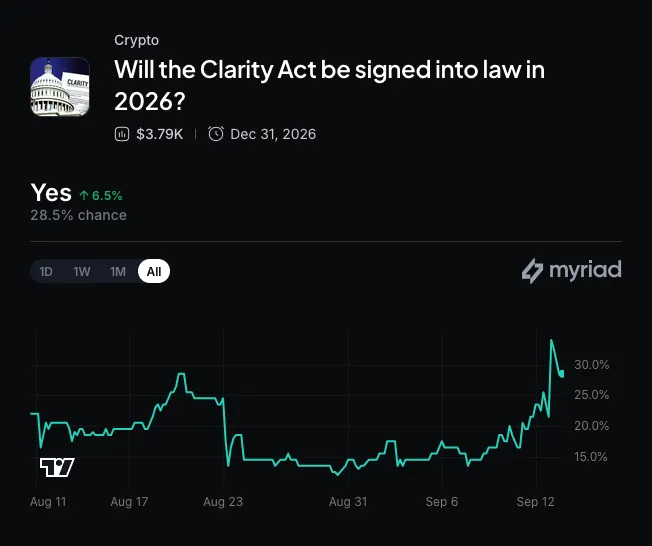
Thorn, who previously put the odds of passage in 2026 at just 10% in a research note, raised them to 25% Monday morning following the release of the new text. But he cautioned that the tight legislative calendar remains a major hurdle, with the House potentially having to take up the Senate version during the lame duck session.
Crypto in America is a newsletter written by Eleanor Terrett. Follow the link to read in full and subscribe.