






In brief
- Crypto liquidations reached $948.22 million in 24 hours across 177,440 traders, with long positions accounting for 90.6%, per CoinGlass.
- Bitcoin fell 2.6% and broke support after hotter-than-expected CPI and PPI data revived bets on another Fed rate hike.
- Bitcoin now trades roughly 2% below the average cost of U.S. spot ETF holders near $82,300, putting those buyers back underwater.
Bitcoin fell below $80,000 on Thursday for the first time in over a month, extending Wednesday’s inflation-driven slide and wiping out nearly $1 billion in leveraged crypto bets. It's currently trading just about $82,000 after several hours of increased volatility.
Ethereum and XRP dropped close to 5%, Zcash sank almost 10%, and only five coins in the top 100 managed gains above 1%. Pick any coin in the top 100 and it's likely in the red today.
Across the market, 177,440 traders were liquidated in 24 hours for a total of $948.22 million, per CoinGlass, with longs accounting for $858.96 million, or 90.6%. Ethereum led with $282.03 million, with Bitcoin just behind at a little over $200 million.
This was the third-heaviest day for long liquidations in the last 90 days, behind October 8 and August 22. The largest single order liquidated yesterday was a $12.03 million Bitcoin long on Binance, force-closed at $80,208.96.
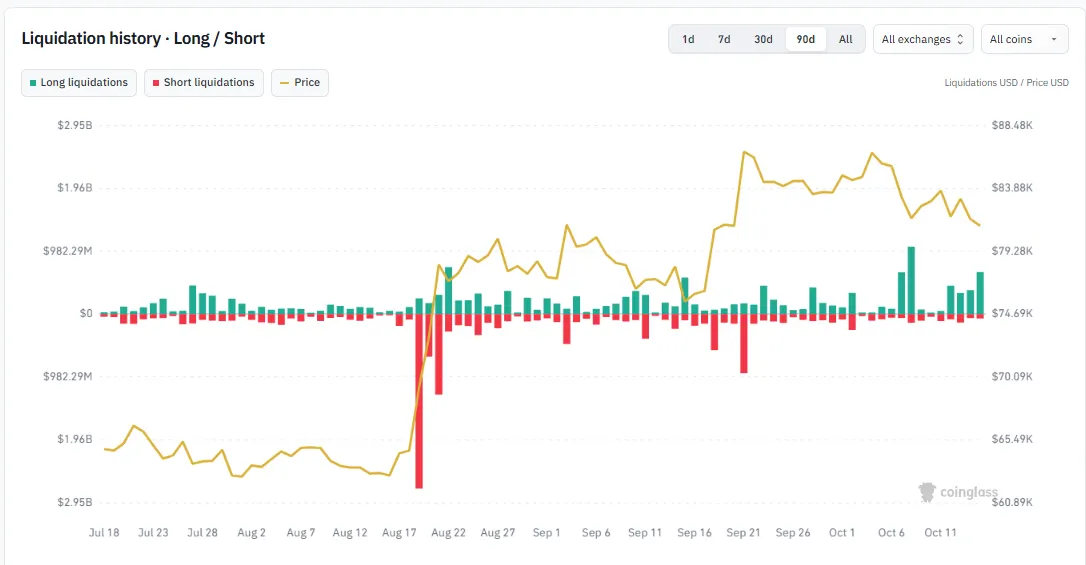
A liquidation happens when a trader borrows to bet on a price move and the market goes the other way. Once losses eat through the collateral, the exchange sells the position automatically, and that forced selling drags prices lower and trips the next batch of leveraged longs.
The trigger was Wednesday’s inflation report, which showed consumer prices up 3.7% year over year in September against a 3.6% forecast, with core inflation at 2.6% against 2.5%. Thursday’s Producer Price Index, which tracks business input costs, rose 6.3% annually versus a 5.5% forecast.
Much of that inflation comes from oil, with Brent crude near $104 a barrel, about 70% above a year ago amid the war between the U.S. and Iran. That feeds into fuel, shipping, and almost everything else that needs to be transported to reach consumers.
Hot inflation pushes the Federal Reserve toward higher interest rates, which lifts Treasury yields, the return investors earn for lending to the U.S. government. A bond paying around 5% with almost no risk makes Bitcoin a harder sell, while higher rates make borrowing pricier and strengthen the dollar, draining the cheap money leveraged crypto traders run on.

 →
→Iliya Kalchev, analyst at Nexo, reads the selloff as a broad exit from risk more than a Fed story, with stocks and copper falling, gold rising and South Korea’s Kospi down about 8%.
“Bitcoin has slipped to the bottom of the $81,000 to $87,000 range it has held since late September, and Glassnode flags $80,000 as the level to watch,” Kalchev told Decrypt. “It is also now roughly 2% below the average cost of U.S. spot ETF holders, near $82,300, after closing above that line on 21 of the 24 days since September 21. That puts ETF buyers back underwater, and reclaiming it is the first test of any rebound,”
On the daily chart, Bitcoin broke below $81,603, the strongest upper support from its August-to-October rally from $62,763 to $87,422, where uptrend pullbacks often stall. The drop reached $79,711 before buyers pulled the price back near $80,925, off a rising trend band near $80,286.
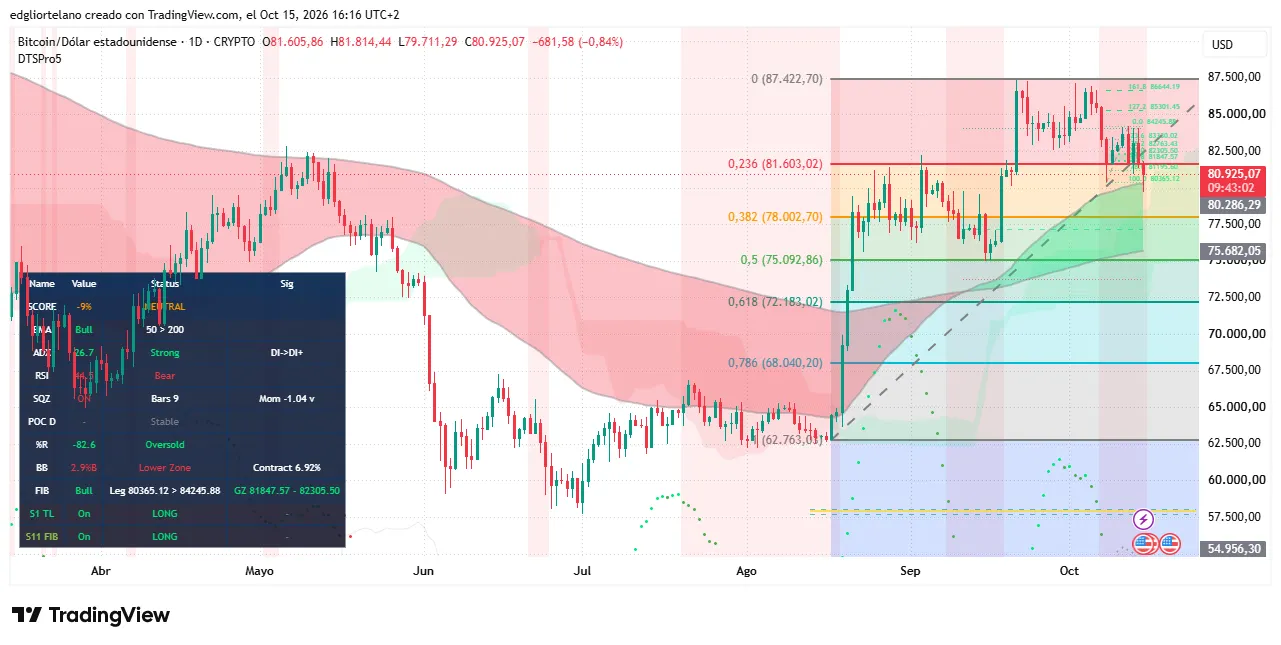
The Relative Strength Index, a 0-to-100 momentum gauge where 50 splits bulls from bears, fell to about 44, while the golden cross still keeps the longer-term uptrend intact.
A daily close back above $81,603 would reopen the path to $84,245 and the $87,422 swing high. Losing $80,286 would expose $78,002 as the next support, and then $75,092.
Kalchev sees early signs the selling is not deepening, including cooling profit-taking, but said a recovery needs more than a bounce.
“Three things need to line up for Bitcoin to push through. ETF flows have to turn consistently positive, after $681 million of outflows last week and a single $177 million inflow day. Selling by long-term holders has to ease,” Kalchev explained.
For Kalchev, a bullish market would require that leverage happens with a sustained buying instead of just a bounce. He added that a “Fed path that stops at one 25 basis point hike would take some pressure off the backdrop.”
The Fed announces its rate decision on October 28, followed by core PCE inflation data the next day and October payrolls on November 6.