





In brief
- Nvidia dropped 18.42% in November through Tuesday afternoon, erasing all its gains for 2026.
- A House Republican chairman threatened to subpoena CEO Jensen Huang unless he responds by November 11 to a request for a closed-door briefing.
- Nvidia's board has opened an independent probe, investors have filed a lawsuit, and competition in AI chips is intensifying.
Nvidia shares plunged to $166.95 Tuesday afternoon, leaving the AI chipmaker down 18.42% for November and wiping out all the gains it had accumulated in 2026.
The selloff accelerated as congressional Republicans threatened to subpoena CEO Jensen Huang over his reported relationship with a suspected Chinese intelligence operative.
At that price, Nvidia was roughly 10.5% below its $186.50 closing price at the end of 2025 and 31.4% below its recent $243.37 peak. November is shaping up as its worst month since September 2022, when shares lost roughly 19.6%; the company suffered an even deeper 32% crash in April of that year.
Tuesday's drop exceeded 6% in afternoon trading, after a 4.3% fall on Monday. The two-day decline was on track to erase more than $470 billion in market value. Even after the significant drop, some analysts would still view the stock as extremely overbought in the long term, with prices much higher than what would be considered safe based on technical indicators.
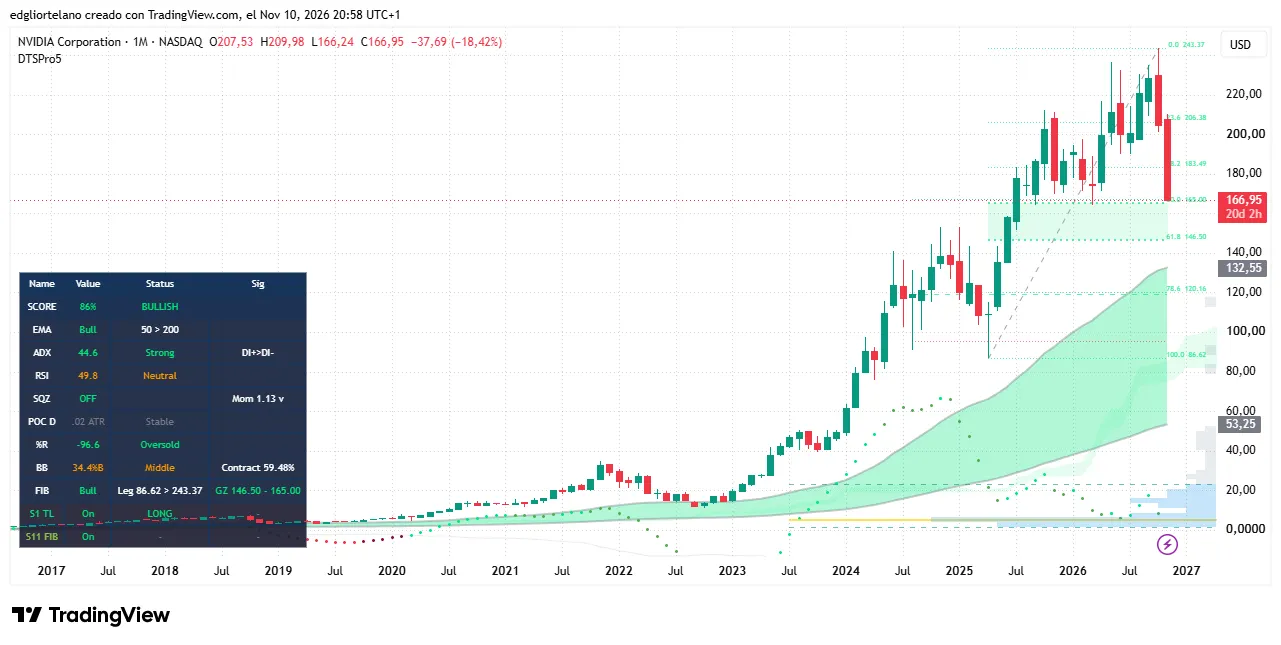
Just for context, even an additional 20% crash (-43% from October) would be considered healthy in an isolated technical analysis, leaving the price still above the average price of the last 50 months. Prices tend to either bounce or trade near that line. When prices go too far away from the average, that usually means there is an unusual appetite for the asset, typically driven more by FOMO than fundamentals.
Congress threatens to compel Huang
House Foreign Affairs Committee Chairman Brian Mast told ABC News on Tuesday that he was prepared to subpoena Huang unless the CEO responded by Wednesday, November 11, to a request for a closed-door briefing. No subpoena had been issued at the time of the report.
Mast and two other Republican committee chairs asked Huang to appear on November 18 and explain his interactions with Alice Huang, a former executive at Singapore-based chip buyer Megaspeed. The lawmakers also want details about Nvidia's safeguards against foreign espionage, according to a letter reviewed by Reuters.
U.S. authorities have reportedly investigated whether Alice Huang, who has no family relationship to the Nvidia CEO, passed information to Beijing. The allegations have not established that Jensen Huang knowingly disclosed confidential information or violated export rules.

 →
On Sunday, Nvidia's board announced an independent investigation into whether its chief executive was targeted by a foreign intelligence operation. The board said it had no reason to believe that national security or company secrets were compromised, but would examine the available information.
Earlier today, the Financial Times reported Nvidia has hired former U.S. prosecutor Joon H Kim to conduct the internal investigation.
The company is also facing legal pressure. Shareholders filed a proposed class-action lawsuit Monday alleging that Nvidia and Huang failed to disclose risks associated with the reported relationship.
Nvidia's other problem: competition from Google
The scandal has landed during a broader reassessment of the AI boom. Investors have questioned how long massive spending on data centers can continue, and Nvidia's competitors are offering customers more alternatives to its expensive chips.
Google introduced new AI chip configurations Monday. The Information reported that OpenAI was considering buying Google's tensor processing units, or TPUs, which are processors built specifically to run AI workloads. Neither company has confirmed a purchase but yesterday Google announced a new line of TPUs available for select customers, directly competing against Nvidia’s chips.
Nvidia is scheduled to report quarterly earnings on November 17, one day before the congressional briefing requested by House Republicans. Mast's deadline for Huang to respond comes first, on November 11.